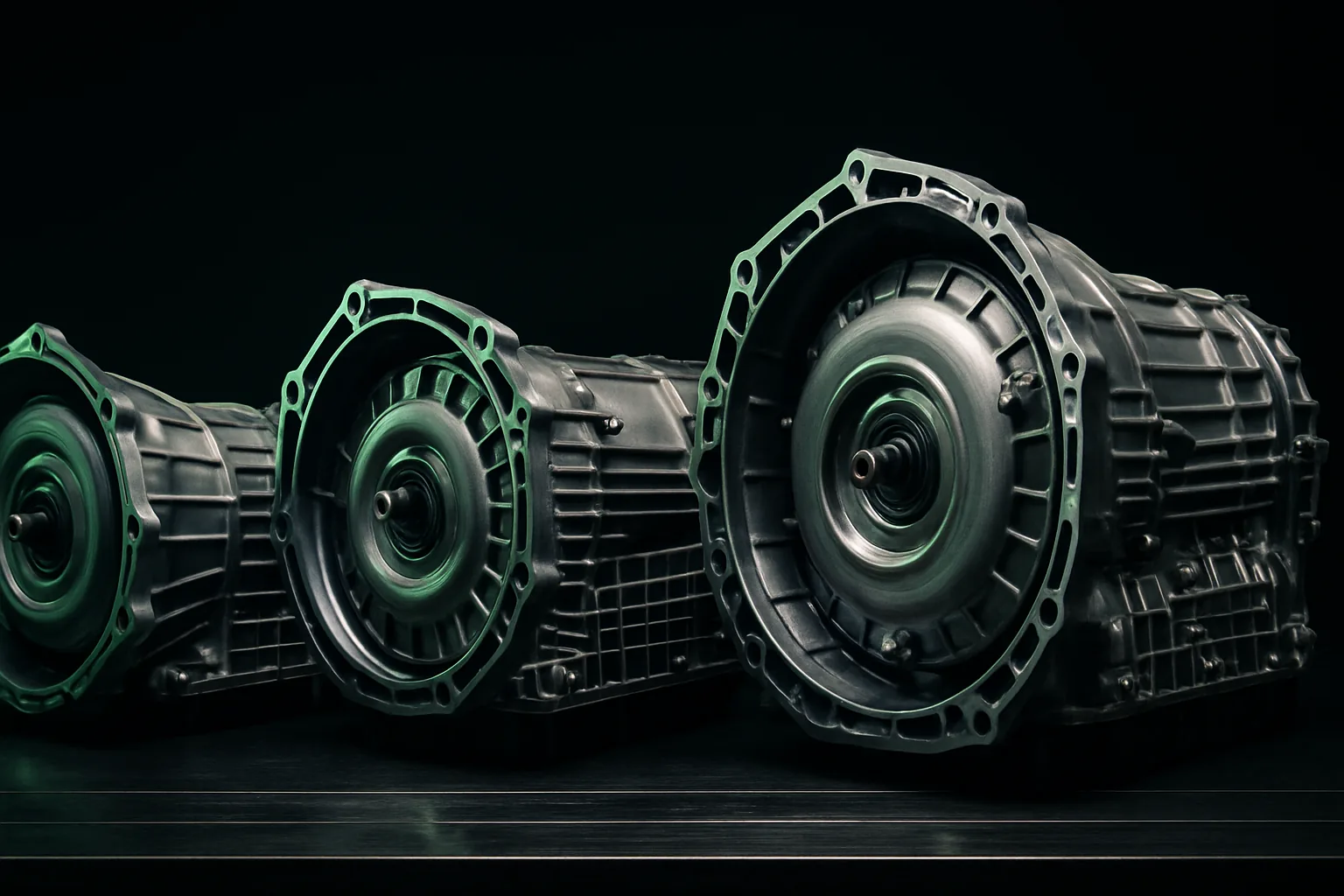
When the ZF 8HP automatic transmission first exploded onto the swap scene, builders quickly ran into the same wall: the factory Transmission Control Module is deeply married to the donor vehicle's CAN network. Put a 2JZ, an LS, or a Barra in front of that 8-speed and the OEM TCU has nothing to talk to. The result is a transmission that does nothing at all — or, at best, a fragile workaround through a parallel CAN emulator. The Turbolamik TCU 2.0 was engineered from the ground up to eliminate that wall. Rather than piggyback on factory communications, it physically replaces the OEM transmission control circuitry at the circuit-board level, placing the builder in direct, unrestricted command of every solenoid and sensor inside the 8HP housing.
This guide covers everything you need to know before specifying a Turbolamik TCU 2.0 for your build: how the PCB-level bypass works, which 8HP variants are supported and what additional parts some require, the eight configurable driving modes and what each delivers, transbrake and digital-clutch operation, the wiring and sensor inputs the controller needs, and why a shop-built, calibrated unit matters enormously when you are putting $1,600 worth of electronics into a transmission that may be holding 700-plus horsepower.

What the ZF 8HP Is and Why Builders Love It
The ZF 8HP is arguably the most widely swapped modern automatic transmission on the planet. Introduced in 2009 and now powering everything from the Dodge Charger Hellcat to the BMW M5 to the Jeep TRX, the 8HP family offers a combination of lightweight construction, compact packaging, excellent torque capacity, and lightning-fast clutch-to-clutch shifts that no older 4L80E or W5A580 can match. The transmission uses a Lepelletier planetary gearset that packs eight forward ratios into a case roughly the same length as a conventional six-speed, and its mechatronics unit — the combined TCU-and-valve-body assembly — integrates electronics and hydraulics into a single serviceable module.
For swap builders, the appeal is obvious: a proven, durable, performance-capable 8-speed available in junkyard abundance from BMW, Dodge, Jaguar, Audi, and Land Rover platforms. Adapter plates for 2JZ-to-8HP, LS-to-8HP, Barra-to-8HP, RB-to-8HP, and many more are commercially available. The transmission itself is often cheaper than a comparable aftermarket 6-speed manual. The sticking point has always been control — and that is exactly the problem the Turbolamik TCU 2.0 was built to solve.
The Turbolamik TCU 2.0: What It Actually Is
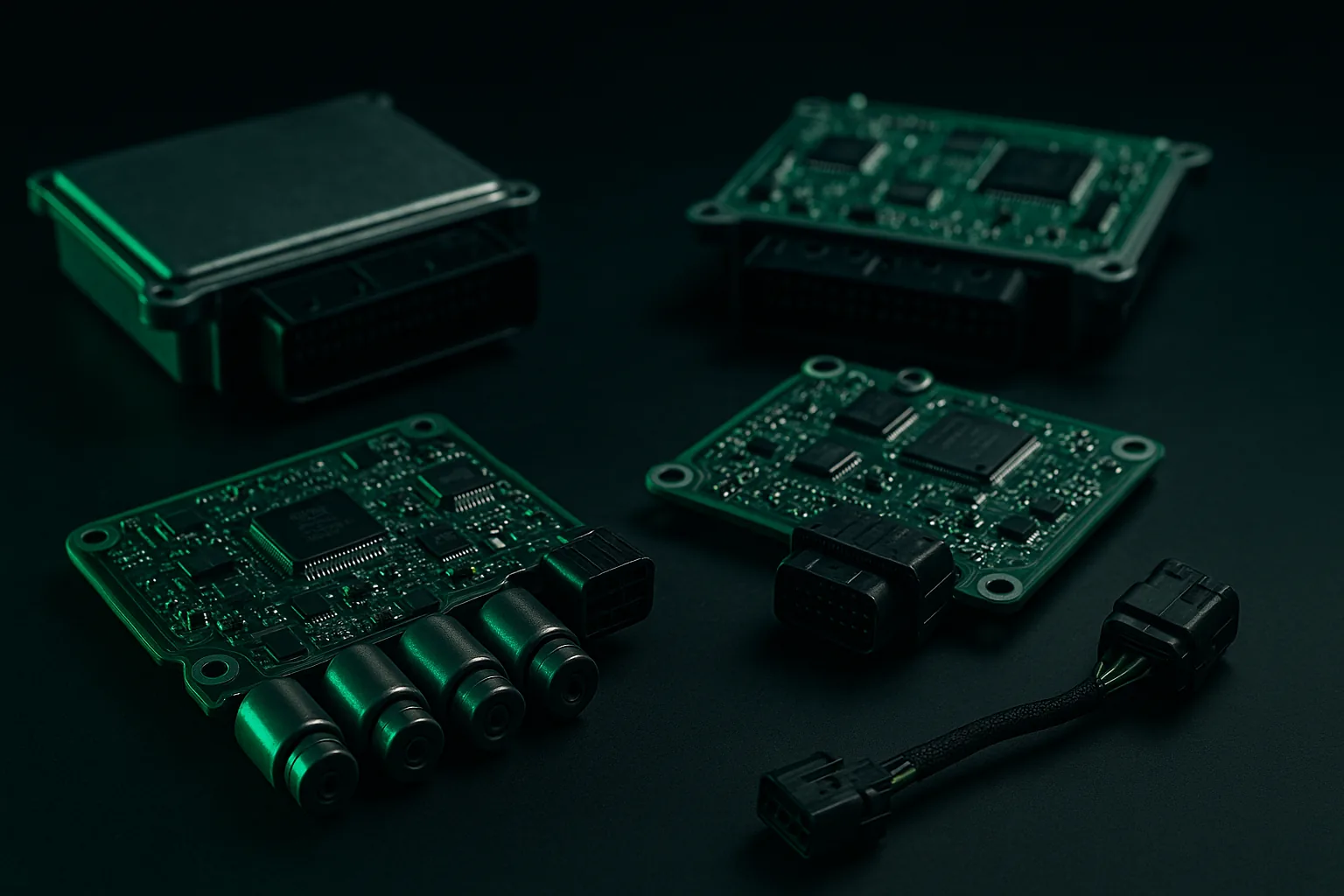
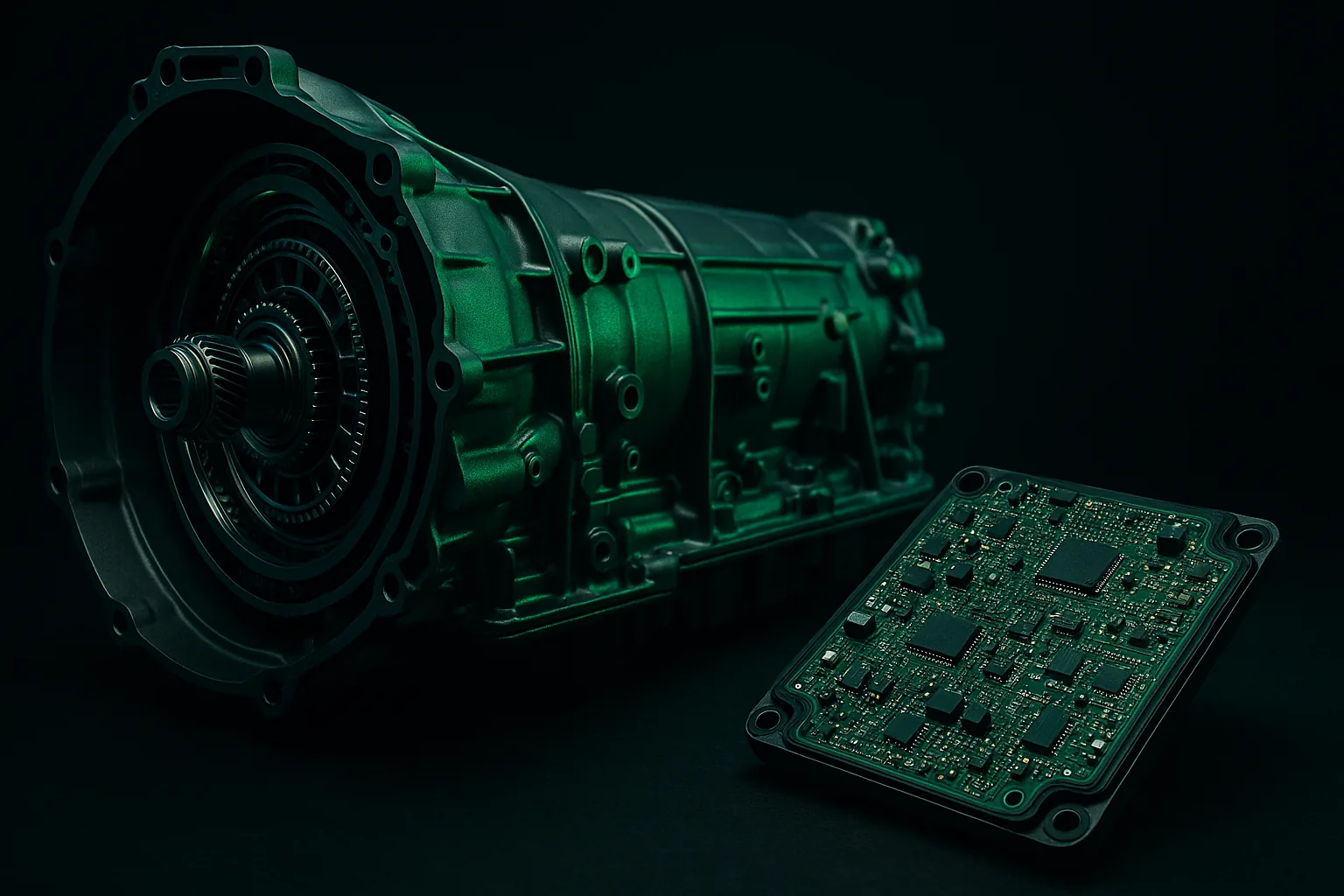
There is a fundamental distinction that matters more than any spec sheet figure: the Turbolamik TCU 2.0 is not a tune, not a piggyback module, and not a CAN emulator. It is a dedicated PCB-level bypass controller that physically replaces the OEM transmission control circuitry inside the original ZF 8HP mechatronics housing.
The installation process requires opening the mechatronics unit and soldering the Turbolamik PCB in place of the factory processor and driver circuitry. Once installed, all hydraulic commands — every shift solenoid duty cycle, every pressure-regulating valve, every lockup and torque-converter command — are executed externally by the Turbolamik unit rather than by ZF's factory firmware. The original ZF TCM effectively ceases to exist as a functional entity. What remains is the 8HP's proven hydraulic architecture, now under the complete authority of the standalone controller.
This approach has direct consequences for both capability and complexity:
- No CAN dependency. Because the Turbolamik takes direct solenoid-level control, it does not need to communicate with a stock engine ECU at all. It can accept engine data (RPM, TPS, MAP, brake signal) from any source — OEM ECU, standalone ECM, or discrete sensors — and it is equally functional with no engine CAN network whatsoever, making it the only practical controller option for pre-CAN-era engine swaps or completely custom builds.
- Full pressure authority. The controller has direct access to all 11 valve control outputs inside the 8HP. Factory torque limiters, shift inhibitors, and adaptation boundaries can all be removed or reconfigured. For motorsport applications, this means the transmission can be tuned to the actual power level of the engine, not ZF's conservative factory limits.
- Irreversible installation. Soldering a PCB in place of the factory processor is a one-way operation on the mechatronics unit. The 8HP cannot revert to OEM operation on the same mechatronics assembly. Plan accordingly: if you need the transmission for street registration in a state that requires OEM compliance, this is the wrong tool. For dedicated race, drift, drag, or off-road builds, it is the right one.
Development History: Ten-Plus Years of Iteration
The Turbolamik TCU 2.0 was the first standalone 8HP controller ever brought to market — a claim that still holds with over a decade of continuous development behind it. The controller has been installed in vehicles ranging from daily-driven street builds to high-horsepower drag cars and has accumulated real-world validation across a remarkably broad range of engine-transmission combinations. That development depth matters: early-generation teething issues around shift adaptation, solenoid mapping across 8HP sub-variants, and transbrake output reliability have been refined through years of builder feedback. What you buy today reflects more than a decade of iteration on a platform that competitors entered years later.
Supported ZF 8HP Variants
The 8HP family spans a torque capacity range from roughly 450 Nm to over 1,000 Nm. Choosing the right variant for your power level is as important as choosing the right controller. The Turbolamik TCU 2.0 supports the following variants natively, with two requiring additional parts:
| Variant | Factory Torque Rating | Common Swap Applications | TCU Support |
|---|---|---|---|
| 8HP45 | ~450 Nm (332 lb-ft) | BMW N20/N26, Jaguar XE, lower-output builds | Native |
| 8HP50 | ~600 Nm (443 lb-ft) | BMW B48/B58 2.0T/3.0T, Alfa Romeo, Jeep | Native |
| 8HP51 | ~600 Nm | Chrysler/FCA applications | Supported — requires 8HP50 valve plate swap |
| 8HP55 | ~600 Nm | Audi applications (mechanical and electronic selector variants) | Native (both selector types) |
| 8HP65 | ~650 Nm | Audi V6/V8 | Native (Audi variant) |
| 8HP70 | ~700 Nm (516 lb-ft) | BMW V8, Dodge 5.7/6.4 HEMI, Jaguar XF/XJ, 2JZ/LS swaps | Native — most popular swap unit |
| 8HP75 | ~750 Nm | BMW G-series V8, RAM 1500 | Native |
| 8HP76 | ~750 Nm | FCA truck/SUV | Supported — requires 8HP75 valve plate swap |
| 8HP90 | ~900 Nm (664 lb-ft) | Dodge Hellcat, Charger/Challenger SRT, high-power builds | Native |
| 8HP95 | ~1,000 Nm | BMW M5 F90, Jeep TRX, Rolls-Royce applications | Native |
A note on the 8HP51 and 8HP76: These Chrysler/FCA-sourced variants share their core hydraulic architecture with the 8HP50 and 8HP75 respectively but use a different valve body configuration. Turbolamik supports them with a valve plate swap to the corresponding BMW-sourced unit. This is a known, straightforward modification — not a workaround — but it is an additional step and cost that must be factored into your build planning. See our companion guide on choosing the right 8HP variant for your swap for a deeper look at the selection decision.
The Eight Driving Modes
One of the Turbolamik's defining features is its eight configurable driving modes, selectable on the fly with the external program switch. These modes are not just shift-point adjustments — each configures a fundamentally different set of shift strategy parameters, solenoid pressure tables, torque converter lockup behavior, and input device logic. The mode range covers the full spectrum from smooth daily-driver comfort to all-out drag-racing aggression:
- Comfort / Street Automatic. Mimics OEM behavior: gentle upshifts, smooth converter engagement, early upshift points. Daily-driver appropriate. The transmission behaves as the factory intended with all the smoothness ZF engineered in.
- Sport Automatic. Elevated shift points, firmer line pressure, more aggressive lockup scheduling. Still fully automatic, but responsive to throttle input in a way that suits spirited street or canyon driving.
- Sport Sequential. Automatic mode with manual override via paddle or sequential shifter. The driver can command shifts at will; the controller holds the selected gear without upshifting on its own.
- Full Manual Sequential. The controller will not auto-upshift under any circumstances. Every gear change is driver-commanded. Rev limiters and over-rev protection remain active. This is the first mode where the transmission truly behaves like a driver-operated sequential gearbox.
- Race / Track. Maximum shift speed, elevated line pressures throughout, aggressive torque converter management. Optimized for sustained lap use where heat management and consistent shift execution matter more than passenger comfort.
- Drag. Purpose-built for the strip: hard, fast shifts timed for minimal power interruption, transbrake activation support, and launch-optimized torque converter scheduling. In this mode, shift times reach the 50 ms end of the 50–150 ms range.
- Drift. Works in conjunction with the digital clutch feature. Shift behavior is tuned for the controlled oversteer requirements of drifting — precise clutch engagement, the ability to clutch-kick and induce rotation, and manual gear hold during sustained slides.
- Off-Road / Custom. A configurable mode for applications outside the other seven categories: hill climb, off-road crawling, or any build-specific requirement. Line pressures, shift points, and converter behavior are adjusted for low-speed traction management and torque delivery rather than shift speed.
Mode switching happens via the external program switch — a physical input, not a laptop command. For builds running the LCD display, the active mode number is visible at a glance. For more detail on how each mode behaves on the road and strip, see our dedicated breakdown: Turbolamik's 8 Driving Modes Explained.
Shift Speed: 50 to 150 Milliseconds
The 50–150 ms shift window is not marketing language — it reflects the physical capability of the 8HP's hydraulic clutch packs under direct electronic pressure control. At the 150 ms end, shift character approaches a firm but comfortable OEM-style change appropriate for street modes. At the 50 ms end, you are in drag-mode territory: a change hard enough to feel in your chest, barely perceptible as a duration, and fast enough that torque interruption is minimized to the point where it barely registers on the dyno trace.
For context: the ZF 8HP in its factory OEM calibration shifts in approximately 200–350 ms depending on conditions and adaptation state. The best standalone CAN-based systems that operate through protocol-level communication generally achieve 100–200 ms. Direct solenoid control at the PCB level removes the communication latency and protocol overhead that constrain CAN-based controllers, which is why the Turbolamik can reach the 50 ms floor that CAN-layer systems cannot physically achieve.
Transbrake: How It Works on the 8HP
A transbrake holds the drivetrain stationary under power by simultaneously applying a forward and reverse clutch pack inside the transmission. The engine builds boost and RPM against a locked drivetrain; on release, the forward clutch wins, the reverse pack releases, and the car launches from a stationary spool rather than from a rolling hit. It is one of the most effective drag-launch tools available and, until standalone 8HP controllers existed, it was simply not possible on an automatic 8HP swap.
The Turbolamik TCU 2.0 includes a dedicated transbrake output signal configurable on its auxiliary outputs. In Drag mode, the transbrake activates on a driver input (typically a thumb button on the steering wheel or shifter), the controller simultaneously commands the appropriate clutch pack pressures to lock the transmission, and releases on button lift. Because the controller has direct authority over all 11 valve outputs, transbrake engagement is consistent and repeatable — not a byproduct of CAN message timing or factory firmware tolerance.
For a full build-spec walkthrough of transbrake setup on an 8HP drag build, see: Turbolamik Transbrake Setup for 8HP Drag Racing.
Digital Clutch: Manual-Car Feel Through an Automatic
The digital clutch (also called virtual clutch) is the feature that makes the Turbolamik uniquely suited to drift builds and builds where the driver wants manual-transmission feel without a manual transmission. The controller emulates a clutch pedal's engagement and disengagement behavior through the 8HP's torque converter and clutch pack control, giving the driver a pedal-operated input that behaves — and critically, feels — like a mechanical clutch.
In practice this means:
- Clutch kicks for initiating rotation in a drift are possible and feel natural. The transmission responds to rapid clutch input the way a mechanical clutch would.
- Burnouts with the clutch partially engaged are achievable, rather than requiring a brake-torque or transbrake procedure.
- Manual starts — feathering the transmission into engagement from idle — feel analog in a way that no torque-converter stall-management system can replicate.
The digital clutch is most effective in Drift mode but is accessible across multiple modes. It is one of several reasons the Turbolamik has become the dominant TCU choice in Formula Drift and grassroots drift competition builds running automatic transmissions. For a deep dive on building a drift car around the digital clutch: Turbolamik Digital Clutch: 8HP Drift Build Guide.
Standalone CAN-Free Operation: Why It Matters for Swaps
Every CAN-based 8HP controller — CanTCU, MaxxECU in 8HP mode, factory TCU reflashes — requires a functioning CAN network carrying engine data. That means the engine management system must speak CAN at a compatible protocol, must be configured to broadcast RPM, throttle position, map sensor, and torque signals on the right addresses, and the TCU must receive and correctly interpret those signals. On a BMW-to-BMW build this is manageable. On a 2JZ into a first-gen Dodge Challenger, a Barra into a Nissan S-chassis, or a small-block Chevy into anything built before 1995, it is an integration project that often costs more time and money than the transmission itself.
The Turbolamik accepts engine data inputs — RPM, throttle position (TPS), manifold pressure (MAP), and brake signal — from any source: CAN bus from a modern standalone ECU, a 0–5V analog signal from a standalone sensor, or even a frequency signal direct from a crank trigger. It natively integrates with over 20 standalone ECU platforms including Ecumaster, Haltech, AEM, MoTeC, Megasquirt, and more. And if none of those are present, the controller can derive a working shift strategy from the analog sensor inputs alone.
The two CAN channels operate at selectable rates (125, 250, 500, or 1,000 kbps), with both channels and all analog inputs freely configurable in the Turbolamik software. For builds using a non-CAN engine where analog-only operation is the plan, that configuration is fully supported and has been proven in thousands of installed units.
What You Need for a Turbolamik 8HP Build
A complete Turbolamik TCU 2.0 build involves more than the controller itself. Here is a realistic parts inventory:
| Component | Required / Optional | Notes |
|---|---|---|
| Turbolamik TCU 2.0 | Required | Base unit, $1,650. Includes USB cable only. Non-returnable. |
| TCU Plug & Pins | Required | Sold separately. Needed to build the main harness connector. |
| TCU Wiring Harness | Required | $525–$650 depending on configuration. CAN or analog harness depending on ECU. |
| PRND CAN Keypad | Required (swap builds) | $350. Provides Park/Reverse/Neutral/Drive selection without OEM column shifter. |
| Program Switch | Required | $45. Selects the active driving mode. Required for mode changes without laptop. |
| LCD Display | Strongly recommended | $85. Shows active mode, gear position, error codes. Near-essential for diagnostics. |
| PCB Modification | Required (internal) | $45. The mechatronics PCB that gets soldered in place of the factory processor. Some kits include this. |
| Mechatronics Service | Required | Opening and modifying the mechatronics unit. Should be performed by a shop experienced with 8HP internals. |
| Engine-to-8HP Adapter | Required (most swaps) | Bellhousing adapter varies by engine family. Price $35–$4,000 depending on engine. |
| Torque Converter | Often required | Stall speed must match engine power curve. Use a unit spec'd for your application. |
| Full Kit (all-in-one) | Optional | $2,365–$2,540. Bundles TCU 2.0, harness, PRND keypad, switch, display, and PCB. |
The ZF 8HP transmission itself is not included in any Turbolamik kit — it is sourced separately from a salvage vehicle or transmission specialist. The most popular swap unit is the 8HP70, which is junkyard-abundant from BMW 5-series, Dodge HEMI platforms, and Jaguar XF/XJ, and is professionally proven to handle 700+ HP and approximately 900 Nm when properly rebuilt and calibrated. For a detailed comparison of variants for your power level, see: 8HP45 vs. 8HP70 vs. 8HP90: Which Variant for Your Swap?
Why Professional Calibration Matters
The Turbolamik documentation itself notes that improper calibration causes rapid transmission failure. This is not a warning to hedge liability — it reflects the physical reality of direct solenoid control. When you bypass the factory TCM and take direct pressure authority over the 8HP's clutch packs, adaptation that the factory firmware handled automatically must now be dialed in manually: correct torque input modeling, clutch pack precharge pressures, adaptation learning windows, shift overlap timing, and converter lockup scheduling all require calibration against the actual engine and drivetrain combination.
A shop-built, calibrated unit — where the mechatronics modification is performed by a technician who has opened dozens of 8HP assemblies, and where the initial mapping is done on a dyno or instrumented test vehicle with the actual engine — dramatically compresses the learning curve and protects the transmission during the early operating hours when adaptation values are being established. It also means your transbrake engagement pressure is correct for your converter, your digital clutch feel is tuned to your application, and your shift speeds in Drag mode are set to the edge of what your clutch packs can sustain rather than a conservative default that leaves performance on the table.
For a detailed look at how the Turbolamik compares to the CanTCU and MaxxECU in terms of calibration complexity, capability ceiling, and the right application for each, see: Turbolamik vs. MaxxECU vs. CanTCU: 8HP Controller Comparison.
Sensor Requirements and Input Wiring
The Turbolamik TCU 2.0 requires the following inputs for full functionality. All are configurable as either CAN-sourced or analog:
- Engine RPM — frequency input from crank trigger, ignition signal, or CAN broadcast. Used for shift-point calculation and torque converter management.
- Throttle Position (TPS) — 0–5V analog or CAN value. Used for load-based shift strategy and kickdown logic.
- Manifold Absolute Pressure (MAP) — 0–5V analog or CAN value. Cross-references throttle position for turbocharged applications where TPS alone is insufficient to characterize engine load.
- Brake Signal — digital input. Used for shift inhibit logic and transbrake release confirmation.
- Vehicle Speed / Output Shaft Speed — sourced from the 8HP's internal output speed sensor. The Turbolamik reads this directly from the mechatronics sensors — no external sender needed.
- Gear Selector (PRND) — from the PRND CAN Keypad or an OEM column/floor shifter with appropriate wiring.
- Digital Clutch Pedal (optional) — for virtual clutch functionality in Drift mode.
The controller provides 11 valve control outputs to the transmission solenoids, 8 low-side auxiliary outputs (0.5A each), and higher-current outputs for transbrake and similar high-draw loads. Software updates are delivered over USB. For a detailed wiring walkthrough covering harness routing, ground plane requirements, and CAN profile selection for common standalone ECUs, see: ZF 8HP + LS Swap: Turbolamik Wiring Harness Guide.
Frequently Asked Questions
Is the Turbolamik TCU 2.0 reversible? Can I put the transmission back to stock?
No. The installation requires soldering the Turbolamik PCB in place of the factory processor inside the mechatronics unit. This is a permanent modification to that mechatronics assembly. However, the ZF 8HP mechatronics unit is a replacement part — if you ever needed to restore the transmission to OEM function (for example, to sell a vehicle), you would replace the mechatronics unit with an OEM unit and reflash it, rather than reverting the modified unit. For dedicated performance builds this is rarely a concern, but it is important to understand before proceeding.
Does the Turbolamik require a CAN bus connection to the engine ECU?
No. This is one of its defining advantages over every CAN-based alternative. The controller can receive RPM, TPS, MAP, and brake inputs as 0–5V analog signals from standalone sensors, as a CAN broadcast from a modern standalone ECU, or as a combination of both. Full standalone analog operation — with no CAN network at all — is fully supported and has been validated in production for over ten years. This makes it the only viable standalone controller for pre-CAN-era engine swaps and custom builds using non-CAN engine management.
What is the difference between the TCU 2.0 base unit and the Full Kit?
The base unit ($1,650) includes the Turbolamik TCU 2.0 controller and a USB cable only. The TCU plug and pins, wiring harness, PRND CAN keypad, program switch, LCD display, and mechatronics PCB modification board are all sold separately or as part of the Full Kit ($2,365–$2,540). For most builds, the Full Kit is the practical starting point because every component in it is required for a functional installation. The base unit purchase makes sense if you are sourcing individual components from multiple suppliers or if a shop is providing harness fabrication.
Which ZF 8HP variant should I use for a high-power LS or 2JZ swap?
The 8HP70 is the overwhelming community consensus for high-power swap applications in the 400–700 HP range. It is junkyard-abundant, has a strong aftermarket ecosystem of adapters and torque converters, and is proven in professional applications to handle significantly more than its 700 Nm factory rating when rebuilt and properly calibrated. For builds above 700–800 HP, the 8HP90 (from Dodge Hellcat/SRT applications) is the correct choice — it is rated to over 900 Nm and has the case and clutch pack size to match extreme power levels. The 8HP51 and 8HP76 are Chrysler-sourced variants that work with Turbolamik but require a valve plate swap — factor that into your build budget and timeline.
Does the Turbolamik TCU 2.0 have a warranty?
Yes — the TCU 2.0 carries a 12-month manufacturer warranty from turbolamik.us. Note that it is explicitly non-returnable and is designated for motorsport use. The warranty covers the controller unit itself, not the mechatronics modification work performed during installation. This is another reason why professional installation matters: improper soldering or mechatronics damage during the PCB replacement is not a warranty scenario — it is a mechanic's error that can render both the mechatronics unit and the controller non-functional.
Got a module that won't cooperate?
Mail-in diagnostics, reflashing, restoration, and custom engineering — nationwide, with a signed report on every job.