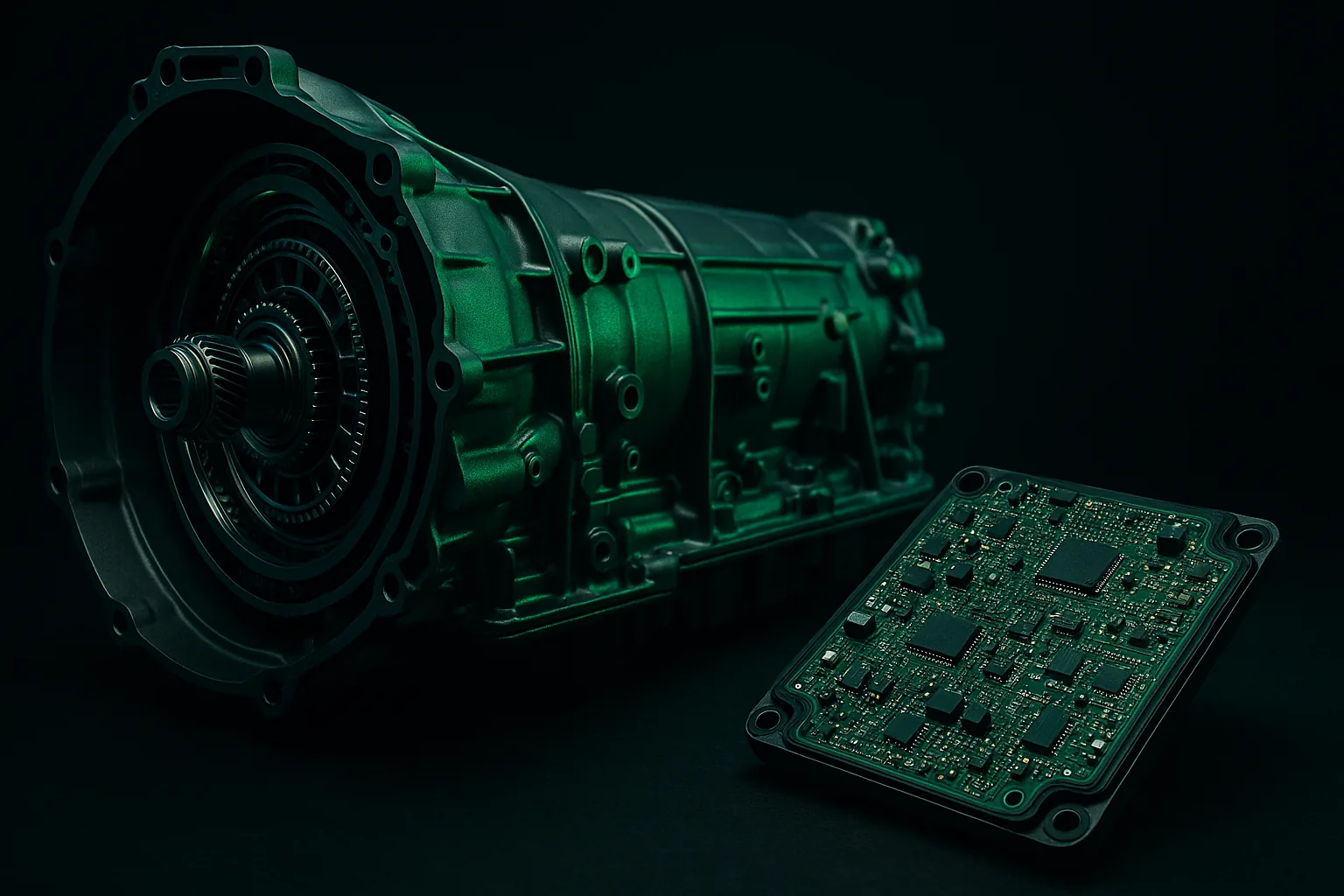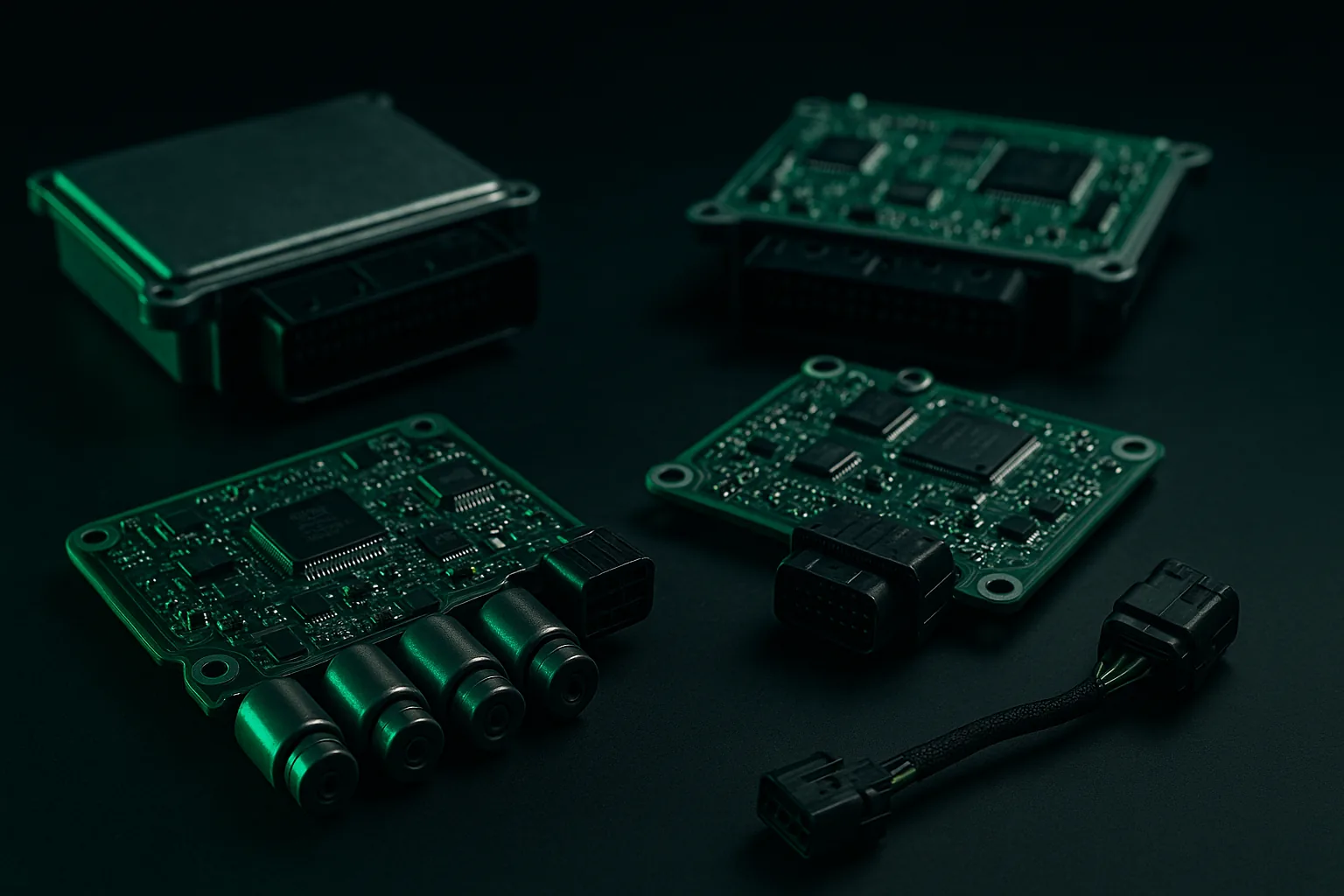
The ZF 8HP is arguably the most swap-friendly automatic transmission ever built. Eight forward ratios, sub-200-millisecond shifts, a compact bellhousing envelope, and aftermarket adapter plates for almost every popular engine block have made it the go-to gearbox for LS swaps, BMW engine transplants, diesel conversions, and dedicated track builds alike. But once you pull the OEM drivetrain out of the donor car, you lose the factory ECU network that tells the transmission what to do — and that is where a standalone transmission control unit (TCU) becomes the linchpin of the whole project.
Three controllers dominate the conversation in 2026: the Turbolamik TCU 2.0, the MaxxECU 8HP control system, and the CANformance CANTCU. Each takes a fundamentally different approach to running the 8HP, and each suits a different type of builder. This guide breaks down how they work, what they cost, and — most importantly — which one belongs in your build.
Why the Control Strategy Matters First
Before comparing features, you need to understand that these three products are not equivalents wearing different labels. They represent two distinct philosophies for how to own the ZF 8HP's mechatronics:
- PCB-level bypass (Turbolamik): The OEM TCU circuit board inside the mechatronic unit is physically replaced by a custom PCB. Every solenoid and sensor wire in the transmission routes directly to the new controller. The factory TCU no longer exists in the system.
- CAN-based gateway (CANTCU, MaxxECU): The OEM mechatronic unit stays in place. An external controller intercepts or replicates the CAN-bus environment the original TCU expects, tricking it into accepting commands from the standalone system. No internal transmission surgery is required.
This distinction drives nearly every trade-off in the comparison that follows.
Turbolamik TCU 2.0: The PCB-Level Pioneer
Turbolamik has been building 8HP controllers longer than anyone else — the company claims to be the first standalone TCU on the market, with more than a decade of continuous development behind the current 2.0 platform. The approach is surgical: a technician opens the mechatronic unit, removes the OEM TCU board, and solders a replacement PCB in its place. From that point forward, every solenoid in the transmission reports directly to the Turbolamik controller.
The payoff for that invasiveness is complete independence from CAN. Because the Turbolamik replaces the PCB entirely, it does not need a CAN-capable engine ECU to issue commands or decode torque signals. You can wire it to an old-school carburetor engine, a standalone EFI unit without CAN outputs, or a custom turbo build running a basic programmable ECU — none of them need to speak 8HP CAN protocol. That is a genuinely unique capability in this space, and it is one of the main reasons that no-CAN engine swaps (classic body swaps, diesel conversions, carbureted performance builds) gravitate toward the Turbolamik platform. For more on the wiring side, see our ZF 8HP LS swap Turbolamik wiring harness guide.
Turbolamik TCU 2.0 Features
- 8 selectable driving modes spanning street automatic, sport, race, drag, drift, off-road, and sequential styles — switchable on the fly. Read a full breakdown in our Turbolamik 8 driving modes explained guide.
- Shift speed: 50–150 ms, configurable by mode
- Transbrake: Available as an option — holds the vehicle at the line against full engine power, then releases on button lift
- Digital clutch: Simulates a manual clutch pedal for drifting, clutch-kick techniques, and burnouts
- Supported transmissions: 8HP45, 8HP50, 8HP55, 8HP70, 8HP75, 8HP90, 8HP95 (8HP51 and 8HP76 need additional components)
- Shifting inputs: Paddle shifters, sequential shifter, or conventional shifter
- Automatic adaptation: Self-learns clutch pack behavior over time
- Diagnostics: Error codes displayed on external display
- No CAN dependency: Analog harness option available for engines without CAN outputs
Turbolamik Pricing (verify current rates at turbolamik.us)
- Base controller: ~$1,650 USD as of 2026
- Full kit (controller + harness + display + switch panel): ~$2,365–$2,540 USD depending on options
- Connectors and pins are sold separately from the base unit
- The internal PCB swap is labor that must be performed by a qualified shop — factor in bench time if you are not doing it yourself
Latimer Technologies builds and programs Turbolamik units as part of our mail-in ZF 8HP conversion service, so customers can send in a bare mechatronic unit and receive a fully configured Turbolamik-equipped assembly ready to bolt in. Learn how we approach programming in our ZF 8HP Turbolamik software development guide.
CANformance CANTCU: The Gateway Approach
The CANTCU, made by CANformance Engineering (Poland), launched in 2021 and has become the most popular CAN-gateway controller for 8HP and BMW DCT transmissions. Rather than replacing anything inside the gearbox, it sits between your engine ECU and the transmission's OEM mechatronic unit, emulating the CAN-bus environment the stock TCU expects. From the transmission's perspective, it still thinks it is living in a factory BMW or Dodge — it just receives different commands.
CANTCU Features
- Supports 40+ ECU platforms including MaxxECU, Emtron, Motec, Haltech, ECUMaster, AEM Infinity, and many OEM systems
- Transmission compatibility: All GEN1/2/3 BMW F-Series and G-Series 8HP, BMW DCT (GS7D36SG/GS7D70SG), plus Dodge, Alfa Romeo, Jaguar, Land Rover, and other OEM 8HP variants
- Inputs: 4 analog inputs, 4 digital inputs, 3 CAN-bus inputs, LIN-bus
- No internal transmission modification required — fully non-invasive and reversible
- Built-in flasher: Unlocks transmission immobilizers without a separate tool
- OBD-II diagnostics and support for third-party tune flashing (xHP, TGFlash, BMW WinKFP)
- All OEM safety features intact — the mechatronic unit's own logic continues to protect clutch packs
- Smooth, factory-quality shifts out of the box; OEM shift calibration is retained (though BMW's stock maps can be sluggish — third-party TCU flashing is recommended for spirited driving)
CANTCU Pricing (verify current rates at canformance.net)
- Standalone controller: ~$1,425 USD / €1,089 ex-VAT as of 2026
- Harnesses and accessories sold separately
- Budget for TCU flashing if you want sportier shift maps — OEM BMW calibration is conservative
The CANTCU's non-invasive design means the installation is reversible and the OEM mechatronics remain untouched. For a builder who wants to preserve resale value or keep a donor car reversible, that matters. The downside: you are still dependent on the condition of the original mechatronic unit, and the system absolutely requires a CAN-capable ECU or a CAN signal generator.
MaxxECU 8HP Control: The All-in-One Engine-Plus-Transmission Platform
MaxxECU is a well-regarded Swedish standalone engine management company, and their 8HP control is best understood as a feature of their ECU platform rather than a dedicated transmission controller. If you are already running a MaxxECU for engine management, adding 8HP control is a natural extension — you get one calibration environment, one logging system, and tight integration between engine and gearbox management.
The MaxxECU approach is CAN-based but with an important twist: it requires reflashing the stock 8HP TCU with custom MaxxECU firmware using an external programmer (the Yanhua ACDP-2 tool). Once reflashed, the MaxxECU ECU communicates with the now-custom-firmware TCU via CAN. The OEM mechatronic hardware stays physically in the transmission, but the software has been replaced. This is distinct from the CANTCU's pure gateway approach — MaxxECU's reflashed TCU firmware is exclusive to MaxxECU and incompatible with OEM systems.
MaxxECU 8HP Features
- Supported transmissions: ZF 8HP45, 8HP70, 8HP90 (GEN1 only as of 2026 — GEN2 and GEN3 not supported)
- Launch control integration with direct ECU link
- Transbrake with bump feature in Manual and Drive modes, first or second gear
- Virtual clutch and clutch-kick functionality for drift applications
- Kickdown: Available for rapid downshifts
- Shifter support: Dodge 8HP, BMW 8HP, sequential, or custom emulation
- Shift maps: Customizable RPM-based shift points (1,500–9,000 rpm range)
- Torque converter lockup management
- Real-time telemetry: Clutch pressures, oil temperature, shift timing all visible in MaxxECU's logging suite
MaxxECU Pricing (verify at maxxecu.com — ECU hardware not included)
- Wiring harness (Dodge or BMW shifter version): ~$368 USD
- Yanhua ACDP-2 TCU programming tool (purchase): ~$738 USD | Rental: ~$138 USD
- Total for harness + tool purchase: ~$1,106–$1,475 USD — not including the MaxxECU ECU itself, which starts around $850–$2,500+ depending on model (MINI, SPORT, RACE, PRO)
- Combined system cost can reach $2,000–$4,000+ when an ECU is factored in
MaxxECU is only relevant if you are committed to that platform for engine management. Using it purely as a transmission controller, while purchasing a separate engine ECU, is generally not cost-effective. However, if MaxxECU is already your engine management choice, the 8HP integration is excellent and the total system cost is competitive.
Side-by-Side Comparison
| Controller | Approach | Needs CAN ECU? | Key Features | Approx. Price (2026) | Best For |
|---|---|---|---|---|---|
| Turbolamik TCU 2.0 | PCB-level bypass — replaces OEM TCU board inside mechatronic unit | No — analog harness option supports no-CAN engines | 8 driving modes, transbrake, digital clutch, 50–150 ms shifts, auto adaptation, error codes, broad 8HP variant support | ~$1,650 controller / ~$2,365–$2,540 full kit | No-CAN swaps (carb, old ECU, diesel), drag/drift builds, full custom builds wanting maximum mode flexibility |
| CANformance CANTCU | CAN gateway — retains OEM mechatronics, external CAN controller | Yes — requires CAN-capable ECU or signal source | Non-invasive, reversible, OEM safety features intact, supports 40+ ECUs, built-in immobilizer flasher, OBD-II diagnostics, analog fallback inputs available | ~$1,425 controller only | Street/track builds with CAN-capable ECU, reversibility needed, wide ECU platform compatibility, DCT applications |
| MaxxECU 8HP | TCU firmware reflash via CAN — replaces stock firmware, retains mechatronic hardware | Yes — requires MaxxECU ECU; CAN communication to reflashed TCU | Deep ECU integration, transbrake, virtual clutch, clutch-kick, full shift maps, real-time telemetry in MaxxECU logger | ~$1,106–$1,475 (harness + tool), plus cost of MaxxECU ECU | Builds already on MaxxECU engine management; GEN1 8HP only (45/70/90) |
Prices are approximate as of 2026. Check current pricing directly with each manufacturer — all three update pricing periodically.
When to Choose Which Controller
Choose Turbolamik if:
- Your engine swap does not have a CAN-capable ECU — classic muscle cars, diesel swaps, carbureted builds, early standalone EFI units
- You want maximum mode flexibility in a single controller: drag, drift, street, and off-road modes are all there from day one
- Your build is a dedicated race or drift car and you want transbrake plus clutch-by-wire in one package
- You are having a mail-in shop (like Latimer Technologies) build the transmission assembly — the PCB swap and configuration can be done on the bench before the trans ever goes into the car
- You want the most established platform with the longest real-world track record and the broadest variant support
Choose CANTCU if:
- Your engine management ECU already speaks CAN and is on CANTCU's 40+ supported list
- You want a non-invasive solution that keeps the transmission reversible to stock
- Your build is a street or track car that values OEM-quality shift refinement out of the box
- You are working with a BMW DCT rather than a hydraulic 8HP — CANTCU supports both
- You want broad firmware flexibility via xHP, TGFlash, or WinKFP for TCU tune flashing
Choose MaxxECU 8HP if:
- You are already committed to MaxxECU for engine management and want one unified calibration environment
- Your transmission is a GEN1 8HP45, 8HP70, or 8HP90 — GEN2/3 are not currently supported
- You value tight ECU-to-gearbox telemetry integration and want everything in one logging session
- You do not mind sourcing and using the Yanhua ACDP-2 programming tool for the TCU reflash step
A Note on Installation and Support
All three solutions require competent installation. The Turbolamik's PCB swap is the most mechanically invasive — opening the mechatronic unit requires cleanliness, appropriate tools, and confidence with electronics. Errors here can damage the transmission, so many builders send the mechatronic unit to a specialist rather than doing the swap themselves. The CANTCU is the most accessible: no transmission disassembly, no soldering, plug-in harnesses, and software that works largely out of the box. MaxxECU falls in between — no internal transmission work, but the TCU reflash step adds a layer of procedure and tooling that can trip up first-timers.
Support channels matter for troubleshooting. Turbolamik has over a decade of community threads, distributor networks, and a US presence at turbolamik.us. CANformance maintains a detailed wiki at wiki.canformance.net and a strong community. MaxxECU's support flows through their ECU documentation and community, which is deep but transmission-specific questions can be harder to answer quickly.
For builders using Turbolamik, our complete Turbolamik TCU guide covers the full installation and configuration process. And if you are still deciding which 8HP variant you have or need, our ZF 8HP45 vs 8HP70 vs 8HP90 comparison will help clarify which unit suits your power level and application.
Our Take
There is no universally best controller here — but there is a best controller for your specific build. The Turbolamik TCU 2.0's PCB-bypass approach gives it a capability no CAN-gateway product can match: it runs entirely without a CAN network, making it irreplaceable in no-CAN swap scenarios. Its eight modes and transbrake make it a favorite for drag and drift builders regardless of CAN capability. The trade-off is that the installation is more invasive and configuration requires more time to dial in.
The CANTCU is the most universally compatible option for CAN-equipped builds. It supports more ECU platforms than anything else in this space, retains OEM safety logic, and delivers refined shift quality without touching the transmission internals. If your build already has a CAN-capable standalone ECU on the supported list, the CANTCU deserves serious consideration.
MaxxECU's 8HP control is excellent but narrower in scope: GEN1 only, MaxxECU-only, and best treated as a bonus feature of an existing MaxxECU engine management investment rather than a standalone transmission solution. Do not buy a MaxxECU ECU purely for 8HP control — at that point the CANTCU or Turbolamik are better value propositions.
Frequently Asked Questions
Can the Turbolamik TCU 2.0 run without any CAN bus at all?
Yes. This is one of Turbolamik's defining advantages. Because the PCB-level bypass replaces the OEM TCU circuitry entirely and bypasses every solenoid and sensor wire internally, the controller does not need a CAN signal from an engine ECU to operate. Turbolamik offers an analog harness specifically for engines and ECUs without CAN capability — carburetor engines, early EFI units, diesel conversions, and legacy standalone systems can all run a Turbolamik-equipped 8HP. CAN-capable engine ECUs can optionally communicate torque data when available, but it is not a requirement.
Does the CANTCU work with a MaxxECU engine management system?
Yes. The CANTCU explicitly lists MaxxECU as one of its 40+ supported ECU platforms. If you are running MaxxECU for engine management and prefer a non-invasive transmission controller approach, CANTCU and MaxxECU can work together via CAN. Alternatively, MaxxECU offers its own native 8HP control feature (requiring a TCU reflash), so you have two paths if MaxxECU is your engine ECU — each with different trade-offs in installation complexity and feature depth.
What ZF 8HP variants does each controller support?
Turbolamik TCU 2.0 supports 8HP45, 8HP50, 8HP55, 8HP70, 8HP75, 8HP90, and 8HP95 — the broadest coverage of the three. The CANTCU supports most 8HP units across GEN1, GEN2, and GEN3 variants plus BMW DCT transmissions. MaxxECU's 8HP control is currently limited to GEN1 (8HP45, 8HP70, 8HP90) and does not yet support GEN2 or GEN3 variants. Always verify current compatibility directly with the manufacturer before purchasing, as support lists are updated periodically.
Which controller is best for a transbrake drag build?
All three offer transbrake functionality, but Turbolamik and MaxxECU are the most established drag racing choices. Turbolamik includes the transbrake as an option with a dedicated drag racing mode, a bump feature, and the digital clutch for staged launches. MaxxECU offers transbrake in both Manual and Drive modes in first or second gear with CAN-integrated launch control. The CANTCU's transbrake capability depends on the paired ECU. For pure drag-focused builds — especially no-CAN swaps — the Turbolamik is the most commonly seen controller at the strip.
Is the Turbolamik installation reversible?
No — the PCB swap is a permanent modification to the mechatronic unit. The OEM TCU board is removed and replaced. This makes Turbolamik a committed modification, appropriate for dedicated build cars rather than street vehicles you plan to return to stock. The CANTCU, by contrast, is fully reversible: the OEM mechatronics remain untouched, and removing the CANTCU restores the transmission to its stock electrical state. MaxxECU's approach involves reflashing the TCU firmware, which is technically reversible with the right tools but not a simple unplug-and-done operation.
Got a module that won't cooperate?
Mail-in diagnostics, reflashing, restoration, and custom engineering — nationwide, with a signed report on every job.