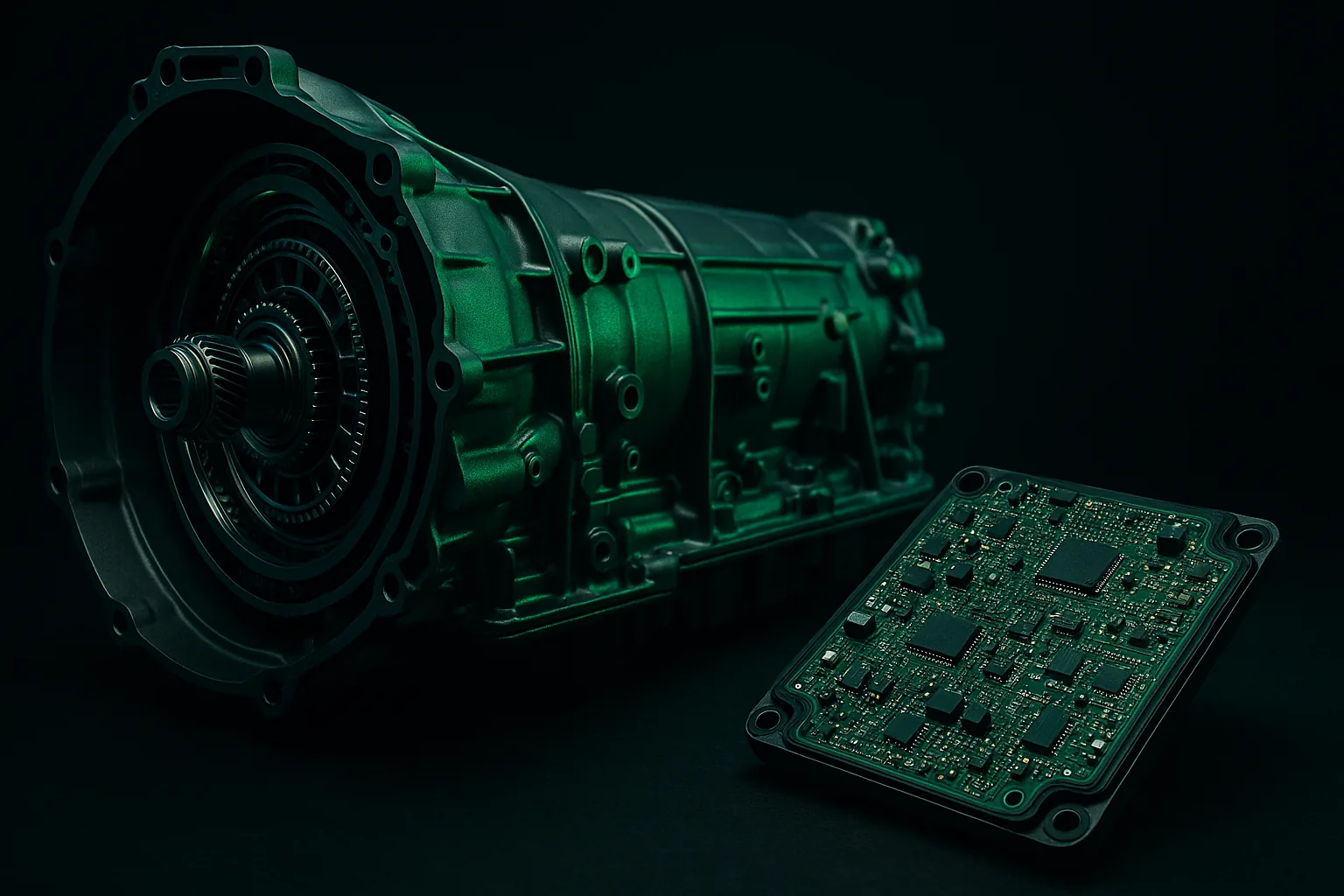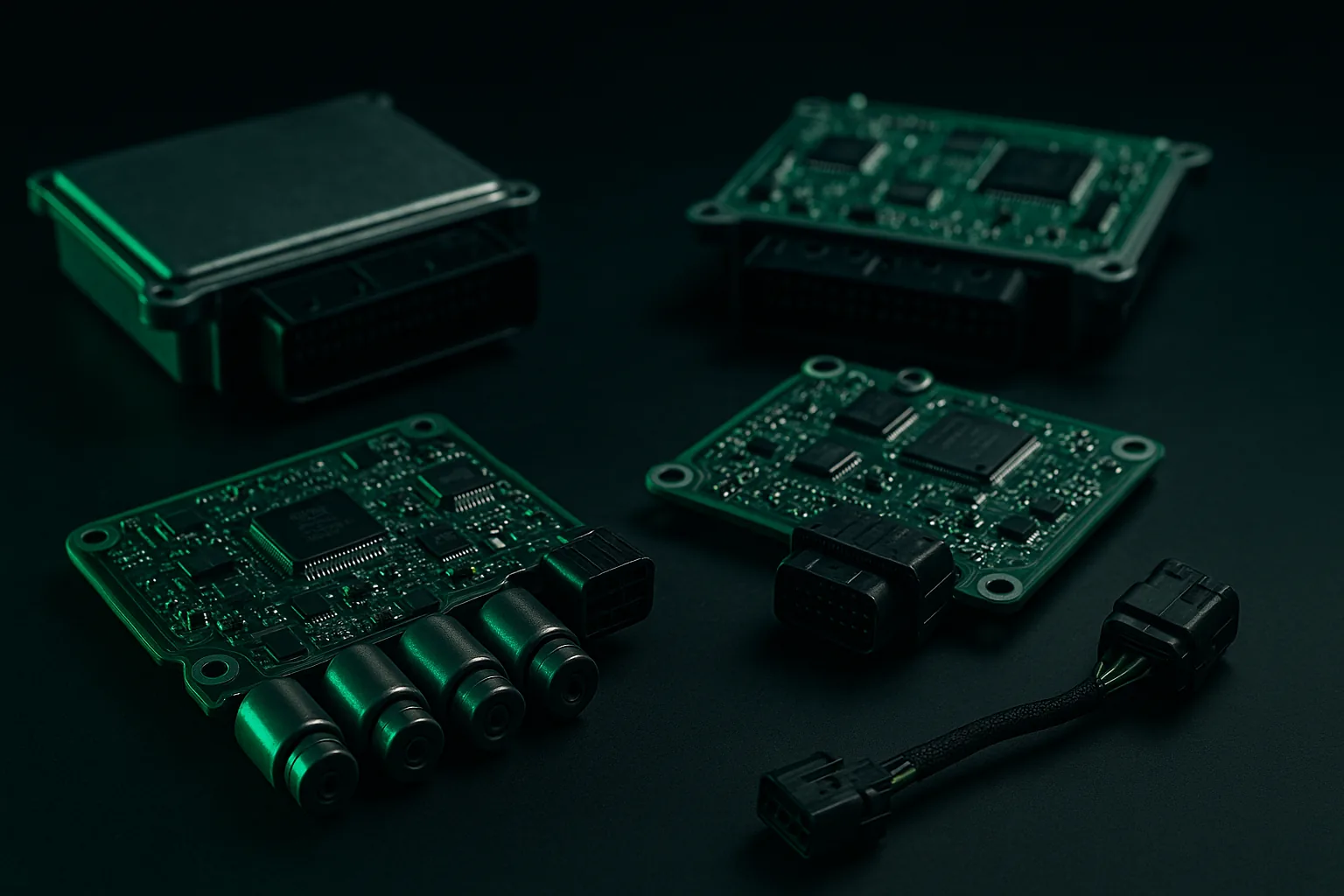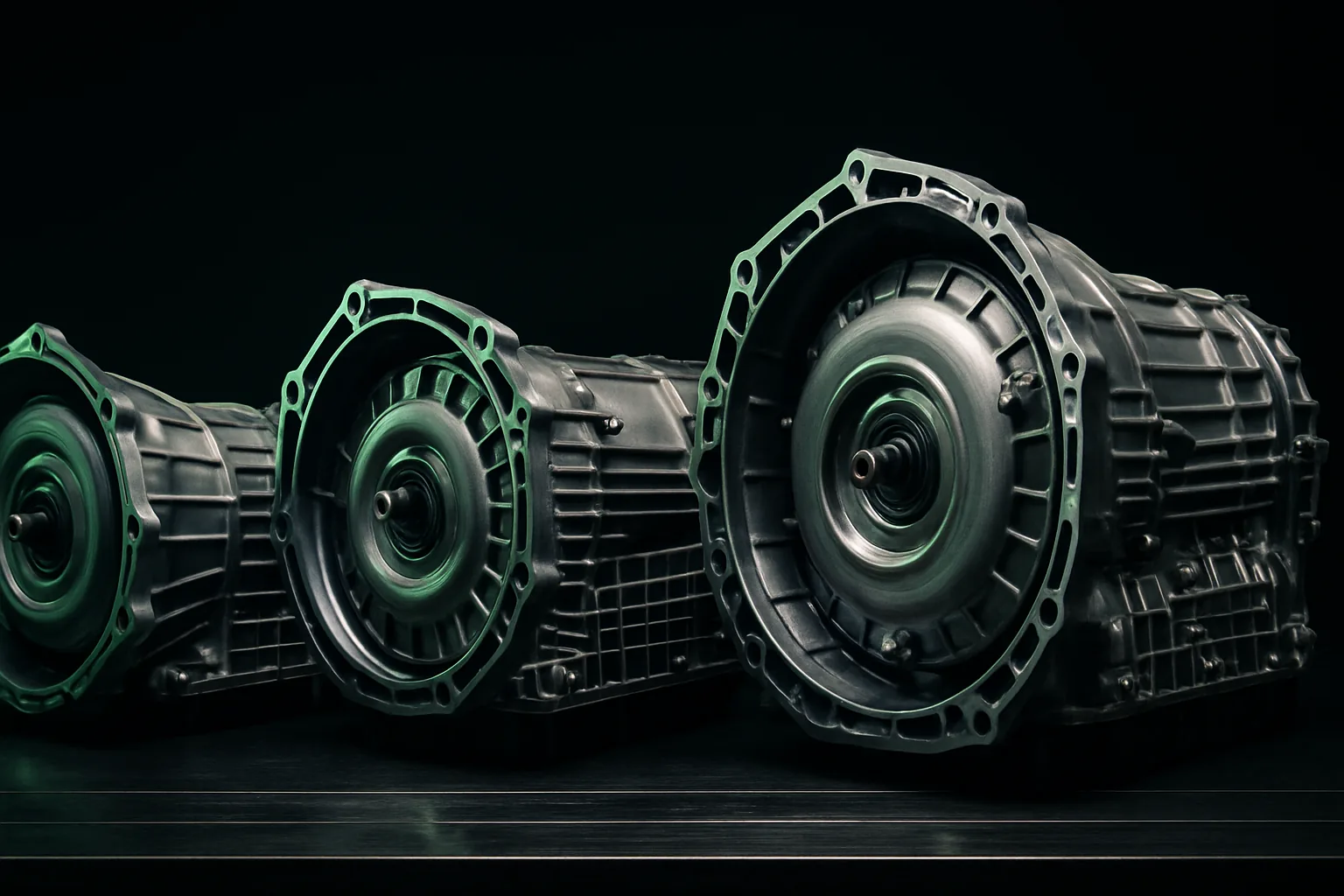
ZF's 8-speed automatic family is one of the most widely adopted transmission platforms on the planet, appearing in everything from a BMW 320i to a Dodge Challenger SRT Hellcat to a Ram 1500 TRX. That breadth is a huge advantage for the swap builder — donor units are plentiful, adapter hardware is mature, and standalone controllers like the Turbolamik TCU 2.0 can run any variant without the donor car's CAN network. But "ZF 8HP" is not a single transmission. The three main families — 8HP45, 8HP70, and 8HP90 — differ meaningfully in torque capacity, physical bulk, cost, and what hardware is needed to mate them to a given engine. Choosing the wrong variant is an expensive mistake; choosing the right one sets the build up for decades of service.
This guide gives you the numbers, the donor vehicle lists, and the decision framework. Whether you are strapping an LS to a Z4 shell, dropping a built HEMI into a classic truck, or chasing four-digit wheel horsepower on a drag car, the variant choice starts with understanding what the name actually means.
How ZF Names Its 8-Speed Variants
The numeric suffix in each model designation is not a model year or a revision code — it is the approximate maximum input torque in Newton-meters. The formula is straightforward:
- 8HP45 — 8 gears, Hydraulic torque converter, Passenger car, 450 Nm input torque ceiling
- 8HP70 — same architecture, 700 Nm ceiling
- 8HP90 — same eight-ratio gear set, 900 Nm ceiling
ZF also produces second-generation variants that carry updated designations: the 8HP50 (500 Nm, Gen 2 of the 45 family), the 8HP75 (740 Nm, Gen 2 of the 70 family), and the 8HP95 (900 Nm, Gen 2 of the 90 family, as found in the Ram TRX). Generation classifications roughly follow a Gen 1 (2010), Gen 2 (2014), Gen 3 (2018) timeline, with each generation introducing internal hard-part changes, revised clutch pack circuits, and updated mechatronic units. Critically, Gen 1 and Gen 2 control systems are not interchangeable — a Gen 1 TCU will not correctly control a Gen 2 unit. When sourcing a donor transmission, confirm the generation before buying a controller or harness. Refer to our generation identification guide for full part-number callouts.
Variant Comparison at a Glance
| Variant | Approx. Input Torque | Weight (with fluid) | Generation | Common Donor Vehicles | Best For |
|---|---|---|---|---|---|
| 8HP45 | 450 Nm (332 lb-ft) | ~77–79 kg (170–174 lb) | Gen 1 (2010) | BMW 320i/320d/420i/520i, Jaguar XE, some Jeep/Dodge light-duty | Light builds, stock-power swaps, tight engine bays, budget builds under ~400 lb-ft |
| 8HP50 | 500 Nm (369 lb-ft) | ~77–80 kg | Gen 2 (2014) | BMW 330d/530d/430d, Jaguar F-Pace, later Chrysler 300 base | Updated Gen 2 alternative to 8HP45 for mild-performance builds |
| 8HP70 | 700 Nm (516 lb-ft) | ~87 kg (192 lb) | Gen 1 (2010) | BMW 550i/650i/750i/X5 M50i, Range Rover, Maserati Ghibli/Quattroporte, Dodge Charger/Challenger 392, Jeep GC SRT 6.4 | The workhorse swap choice — V8 builds from 500–1,000+ hp with aftermarket internals |
| 8HP75 | 740 Nm (546 lb-ft) | ~88–90 kg | Gen 2 (2014) | BMW M550i, later Range Rover Sport, some Audi SQ5/SQ7 | Gen 2 equivalent of the 8HP70; preferred when sourcing post-2014 BMW/LR donors |
| 8HP90 | 900 Nm (664 lb-ft) | ~95–100 kg (209–220 lb) | Gen 1 (2010) | Dodge Challenger/Charger SRT Hellcat, Jeep Grand Cherokee Trackhawk, Rolls-Royce Ghost/Wraith/Phantom | High-torque V8/V12 swaps, supercharged builds above 700 hp, drag applications |
| 8HP95 | 900 Nm (664 lb-ft) | ~96–102 kg | Gen 2 (2014) | Ram 1500 TRX (6.2L supercharged HEMI), Dodge Hellcat Redeye, Durango SRT Hellcat | Gen 2 high-torque; heavier and pricier but newer-generation electronics |
Torque figures represent ZF-published input torque ratings. Real-world burst capability with aftermarket internals exceeds these figures, but sustained reliability depends on heat management and shift calibration.
The 8HP45 — The Light-Duty Option
The 8HP45 is the entry-level variant and the most common ZF 8-speed in the wild. Its 450 Nm (332 lb-ft) ceiling makes it suitable for stock and mildly upgraded four-cylinder and light-six applications. In the BMW world it lives behind the N20 four-cylinder and the N47 diesel; in the Chrysler/FCA ecosystem it appears in lighter-duty applications and some base Jeep Grand Cherokee configurations. Jaguars (XE, early F-Type four-cylinder) also use it.
For swap builders, the 8HP45 has one major advantage: it is cheap and abundant. A low-mileage pull from a wrecked BMW 3 Series can be sourced for a fraction of what a donor Hellcat transmission costs. The trade-off is obvious — even a modestly built LS1 at 450–500 lb-ft will live at or past this transmission's ceiling under hard acceleration. The Gen 2 variant (8HP50, rated to 500 Nm / 369 lb-ft) extends the envelope slightly and is found in BMW 330d, 530d, and 430d applications from 2014 onward.
When the 8HP45 Makes Sense
- Stock-power engine retains with a reliability or fuel-economy upgrade goal
- Four-cylinder turbo swaps (2JZ with conservative tune, K20, EJ with low boost)
- Weight-sensitive builds where every kilogram counts — roughly 8–10 kg lighter than the 8HP70
- Budget-first projects with plans to upgrade later
If your target power level is anywhere near 500 lb-ft — or if you plan to tune aggressively over time — start with the 8HP70 instead. The cost delta rarely justifies the risk of grenading a 45 unit mid-build and sourcing a replacement.
The 8HP70 — The Swap Builder's Default
Ask any experienced swap builder which ZF 8-speed to start with and the answer is almost always the 8HP70. At 700 Nm (516 lb-ft) from the factory, and with a well-established aftermarket in billet converter clutches, upgraded clutch packs, and reinforced shift solenoids, the 8HP70 handles V8 builds in the 600–900+ hp range with confidence when properly supported. Its 87 kg (192 lb) fighting weight is competitive with a built TH400 and lighter than most comparable automatics at its torque rating.
Donor options are exceptional. BMW alone installed the 8HP70 behind the N63 and S63 V8 in the 550i, 650i, 750i, X5 50i, and X6 50i — all common in salvage yards. Range Rover Sport and Discovery models from 2014 onward use it behind the supercharged 5.0 V8. The Maserati Ghibli and Quattroporte use BMW-cased 8HP70 units. In the Mopar world, the Dodge Charger and Challenger with the 6.4L 392 HEMI (Scat Pack/392 variants) use the 8HP70, as does the Jeep Grand Cherokee SRT with the 6.4L engine — making those donors extremely common and well-priced in the used market.
Bellhousing and Adapter Considerations
This is where the 8HP70 demands careful attention: BMW-cased and Mopar-cased 8HP70 units are not interchangeable. Each manufacturer specifies its own bellhousing bolt pattern, torque converter pilot diameter, and output flange configuration. An 8HP70 pulled from a BMW 550i will not bolt to a Dodge HEMI adapter plate without a BMW-specific adapter — and vice versa. When selecting adapter hardware, match the donor brand explicitly. PMC Motorsport, LOJ Conversions, and similar vendors offer bolt-pattern-specific kits for LS-to-BMW-8HP, LS-to-Dodge-8HP, and other common pairings. See our bellhousing adapter selection guide for donor-by-donor breakdowns.
For LS and LT engine swaps specifically, the 8HP70 is the most frequently paired ZF unit. Tunneling is generally comparable to a T56 manual — minimal modification required in most RWD chassis — and several vendors offer complete plug-and-play adapter kits. The bellhousing does require clearancing for the LS starter snout; most kits address this with a relieved adapter plate rather than requiring transmission housing modification.
The 8HP75 (Gen 2 8HP70)
The Gen 2 equivalent — the 8HP75, rated to 740 Nm (546 lb-ft) — appeared in BMW M550i, late Range Rover Sport, and some Audi applications from 2014 onward. It shares the same external dimensional envelope as the 8HP70 but has revised internals and updated mechatronic controls. If you source a post-2014 BMW or Land Rover donor, you may receive an 8HP75 rather than an 8HP70. Both are excellent; the 8HP75 edges ahead on torque capacity and benefits from later-generation manufacturing tolerances. Confirm which generation you have before ordering a wiring harness — see our harness guide for generation-specific pinout differences.
The 8HP90 — For When Torque is the Point
The 8HP90 exists because some engines simply outgrow 700 Nm. At 900 Nm (664 lb-ft) rated input torque and a real-world burst capacity that tuners and builders regularly report pushing past 1,000 lb-ft with appropriate converter and clutch pack upgrades, the 8HP90 is the unit for serious power builds. It is heavier (approximately 95–100 kg versus 87 kg for the 8HP70), physically larger, and noticeably more expensive to source, but for a supercharged, turbocharged, or nitrous-assisted build targeting 700+ hp it is the correct starting point.
The most common donor is the Dodge Challenger or Charger SRT Hellcat (6.2L supercharged HEMI, ~707–717 hp). Every Hellcat uses the 8HP90 — it is the only variant Dodge trusted behind that engine from day one. The Jeep Grand Cherokee Trackhawk (also 6.2L supercharged HEMI, ~707 hp) uses the same unit. Rolls-Royce Ghost, Wraith, and Phantom models use an 8HP90 as well, though the Rolls-Royce bellhousing pattern differs from the Mopar pattern and those units command a significant price premium that rarely makes them good swap donors.
The Gen 2 version — the 8HP95 — appears in the Ram 1500 TRX (6.2L supercharged HEMI, ~702 hp), the Dodge Hellcat Redeye, and the Durango SRT Hellcat. It shares the same external torque rating as the 8HP90 but incorporates second-generation hard-part and control system updates. As with the 70/75 pairing, the 8HP95 requires Gen 2-compatible controller software and harness pinouts.
Size and Weight Gotcha
The 8HP90 is physically wider and longer than the 8HP70, and its input shaft is larger in diameter. You cannot use an 8HP70 torque converter on an 8HP90 — the input shaft spline count and diameter differ. If you are upgrading from a 70 to a 90 inside the same chassis, verify crossmember/transmission mount position (real-world swap data from the Ram 1500 platform shows the 8HP90 requires moving the rear mount bracket approximately 1-1/8 inches rearward versus the 8HP70 position). Budget for a new billet converter matched to the 90 unit. Adapter plates from the BMW or Jaguar 8HP70 housing will not fit the 8HP90 Mopar housing — source a Mopar-specific adapter for LS-to-Hellcat-8HP90 builds.
RWD vs AWD Variants — Pick the Right Transfer Case
Within each torque family, ZF offers both rear-wheel-drive and all-wheel-drive (xDrive/4WD) variants. AWD units (sometimes designated with an "A" suffix or "X" in the part number) incorporate an integrated transfer case and differ substantially in length, weight, and output shaft configuration. Converting an AWD 8HP unit to RWD is almost never cost-effective — the internal transfer case assembly is integral to the housing, and the swap involves more machining than simply sourcing a purpose-built RWD unit. When pulling from a BMW X5, X6, or any xDrive model, verify the unit is the RWD version (typically sourced from non-X or M-Sport rear-axle-only variants) or budget for a complete RWD replacement case. LOJ Conversions and PMC Motorsport list donor-specific RWD/AWD callouts in their adapter kit listings. For more on planning driveshaft length and final drive ratios around your chosen unit, see our gear ratio and final drive planning guide.
The Role of a Standalone TCU
Every ZF 8HP variant was designed to operate as part of a complete OEM CAN bus network. The factory TCU receives real-time torque requests from the engine ECU, uses that data to time clutch apply and release with precision, and protects the clutch packs from slippage events that generate heat and wear. Without an engine ECU that speaks the correct ZF CAN protocol, the transmission either will not engage or will behave erratically — defaulting to limp mode, refusing to upshift, or applying shifts harshly enough to cause immediate damage.
For swap applications, the solution is a standalone TCU. The Turbolamik TCU 2.0 supports all six of the variants discussed in this guide — 8HP45, 8HP50, 8HP70, 8HP75, 8HP90, and 8HP95 — as well as the 8HP55 and several other sub-variants (with 8HP51 and 8HP76 requiring supplementary hardware). It installs by removing the factory TCU PCB from inside the mechatronic unit and soldering in a Turbolamik interface board; all shift commands are then executed externally by the standalone controller. The system supports eight driving modes from OEM automatic to full race, manual and paddle-shift operation, and an optional transbrake function for drag applications. Latimer Technologies supplies and programs Turbolamik TCU kits matched to your specific transmission variant — if you are not certain which generation your unit is, we can identify it from the case ID stamp before you order.
Power Level Decision Guide
Use the following as a starting framework. These are practical guidelines informed by builder experience, not manufacturer warranty claims:
- Under 400 lb-ft / ~500 hp at crank: 8HP45 or 8HP50 is viable. Budget-friendly, widely available. Upgrade path limited without replacing the unit.
- 400–650 lb-ft / 500–800 hp: 8HP70 or 8HP75 is the correct call. With a quality billet converter and proper clutch pack upgrades, this range is well within the transmission's sustainable envelope.
- 650–900+ lb-ft / 800–1,200+ hp: 8HP90 or 8HP95 only. The 8HP70 can handle burst torque in this range on a drag car with a careful tune, but sustained track or street use above ~650 lb-ft at the transmission input will accelerate clutch pack wear significantly. Build on the right foundation.
- Above 1,000 lb-ft sustained: 8HP90 or 8HP95 with full billet internals, a high-stall billet converter, and active fluid cooling. Achievable, and actively done in the drag community — but the transmission alone is not the limiting factor at that level; thermal management and converter selection are.
For a deeper look at what the 8HP90 can handle at the top end of that power range, see our dedicated build article on ZF 8HP90 LS builds at 1,000 Nm and beyond.
Sourcing Notes and What to Inspect
All three variants are available through salvage yards, dedicated import transmission suppliers, and remanufacturers. A few sourcing principles to live by:
- Match the bellhousing to your donor engine family, not just the torque variant. A BMW-cased 8HP70 and a Dodge-cased 8HP70 require completely different adapter plates. Confirm the housing manufacturer before purchasing adapter hardware.
- Confirm RWD vs AWD before pulling the unit. AWD cases are heavier, longer, and incompatible with RWD adapter kits without significant rework.
- Verify generation (Gen 1 vs Gen 2) from the case ID or part number. Gen 1 and Gen 2 mechatronic units are not interchangeable, and some standalone controllers are generation-specific. The Turbolamik TCU 2.0 supports both, but harness pinouts differ.
- Check the mechatronic sleeve condition on any used unit. The mechatronic connector sleeve is a known failure point on all 8HP variants — cracks allow transmission fluid to contaminate the electrical connector, causing erratic behavior. A visual inspection and a fluid smell check at the connector takes 30 seconds and rules out the most common used-unit gotcha.
- Confirm the torque converter is included and undamaged. 8HP torque converters are not interchangeable across the three variant families (the input shaft diameter differs between the 45/70 and 90 families), so a missing converter means sourcing a replacement matched specifically to your unit.
Frequently Asked Questions
Can I swap an 8HP45 for an 8HP70 inside the same car?
Yes, and it has been done in BMW platforms (E- and F-series 3 Series being the most common example). Both units share a similar external footprint, but you will need a matched torque converter for the 8HP70, a recoded or replaced TCU (the factory TCU VIN-locks to the original transmission), and in most cases a new transmission mount or crossmember bracket because the two units differ slightly in length and mounting point geometry. A standalone Turbolamik TCU eliminates the VIN-lock issue entirely and is the preferred approach for any performance swap regardless of which variant you are upgrading to.
What is the real-world torque limit of the 8HP90 with aftermarket parts?
Factory-rated at 900 Nm (664 lb-ft), the 8HP90 with an upgraded billet torque converter and reinforced clutch packs is regularly subjected to 1,000–1,200 lb-ft in drag racing applications. Sustained street driving at those levels requires aggressive fluid cooling (a dedicated transmission cooler with thermostatic bypass is considered mandatory above 800 hp), and shift calibration matters enormously — a well-tuned Turbolamik profile that ramps shift pressure gradually causes far less clutch wear than a hard-shift map at maximum pressure.
Do I need the same bellhousing if swapping from a BMW donor vs a Dodge donor?
Yes — this is one of the most critical sourcing decisions. BMW and Dodge/Mopar bellhousing bolt patterns, torque converter pilot diameters, and front pump configurations are different even on units with the same HP designation (e.g., both use an 8HP70 rated to 700 Nm but they are not physically interchangeable). Always match the adapter plate to your specific donor brand. If you are building an LS-to-ZF swap, specify whether your 8HP70 came from a BMW, Jaguar/Land Rover, or a Mopar application when ordering adapter hardware.
Is the Turbolamik TCU compatible with all three ZF 8HP variant families?
Yes. The Turbolamik TCU 2.0 supports the 8HP45, 8HP50, 8HP55, 8HP70, 8HP75, 8HP90, and 8HP95 — covering the full range of Gen 1 and Gen 2 units discussed in this guide. The 8HP51 and 8HP76 (AWD-specific sub-variants) require additional hardware beyond the base kit. The controller installs by replacing the factory PCB inside the mechatronic unit, completely bypassing the OEM CAN bus requirement and allowing the transmission to operate with any engine management system. Latimer Technologies can pre-program and bench-test the TCU against your specific variant before shipment.
What does the ZF 8HP transmission weigh, and will it fit my tunnel?
Approximate weights with fluid: 8HP45 is roughly 77–79 kg (170–174 lb); 8HP70 is approximately 87 kg (192 lb); 8HP90 runs approximately 95–100 kg (209–220 lb). In terms of tunnel fitment, the 8HP70 is broadly comparable in length to a T56 six-speed manual and fits most traditional RWD tunnel profiles with minimal modification. The 8HP90 is physically wider and slightly longer — expect to verify crossmember position and potentially relocate the rear mount. AWD variants of any family are significantly longer and heavier due to the integrated transfer case and should not be confused with their RWD counterparts during test-fitting.
Got a module that won't cooperate?
Mail-in diagnostics, reflashing, restoration, and custom engineering — nationwide, with a signed report on every job.